
Simulate
About Trooba
Built by manufacturing people, for manufacturing decisions
Trooba was born from a simple observation:
Factories can have available capacity and still struggle with long lead times.
The reason is often not a lack of machines or people. It is what happens between operations—queues, variability, lot sizes, shared resources and changing demand.
Trooba Flow was created to make those invisible dynamics visible.
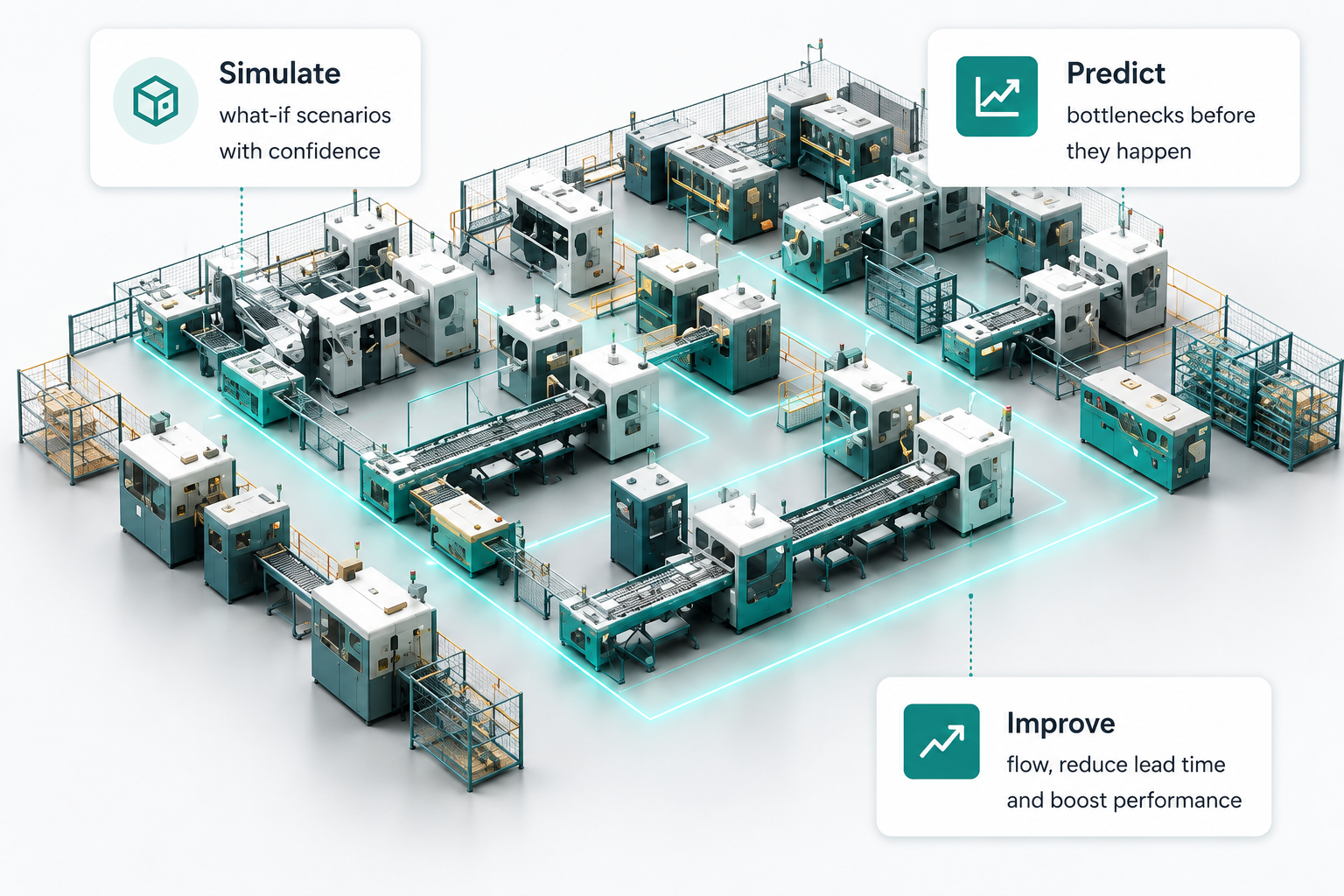
Using the manufacturing data companies already have, Trooba models how work actually flows through a factory, predicts where bottlenecks and queues are likely to emerge, and helps teams test improvement scenarios before making changes on the shop floor.
Our story
From a simple observation to a powerful platform.
Trooba was born from a simple observation:
Factories can have available capacity and still struggle with long lead times.
The reason is often not a lack of machines or people. It is what happens between operations—queues, variability, lot sizes, shared resources and changing demand.
Trooba Flow was created to make those invisible dynamics visible.
Improve
Our team
Decades of Manufacturing Experience
Trooba was founded by Raghu Gidda, an Industrial Engineer with more than two decades of experience across manufacturing, enterprise systems and operational transformation.
Raghu studied Quick Response Manufacturing under Prof. Rajan Suri at the University of Wisconsin–Madison and has applied these principles in real manufacturing environments.
In a high-mix jewellery manufacturing operation, redesigning factory flow helped reduce manufacturing lead time from approximately 28 days to 7 days without adding core production capacity.
That experience became the foundation for Trooba.
-

Raghu Gidda (Founder) -

Vishwanath Srirangam (Chief Technical Architect) -

Shakti Sharma (Business Development Manager) -

Raviteja Vasa (Marketing Manager) -

Karipe Neeraj Kumar (Lead Technology Engineer) -

Sai Varun Somi Setty (Lead Technology Engineer) -

Guntuku Akanksha (People Operational Manager) -

SURAJ D KAMMAR (Industrial Engineering Specialist)
Our mission
We believe manufacturers should be able to understand how their factory will behave before they add capacity, increase inventory or change the shop floor.
Trooba is building the Factory Flow Intelligence layer to make that possible.
-
See
what’s really happening
-
Predict
bottlenecks and delays
-
Simulate
scenarios with confidence
-
Improve
flow and drive better outcomes
See how work really flows through your factory.
Share a small set of factory data and see where queues, bottlenecks and hidden capacity are affecting performance.